Floods wipe out local governments’ ability to lead rescue, relief
The constitution designates the local level as the primary responder to an emergency but Wednesday’s flood has left people’s councils crippled. The absence of roads and electricity has made it difficult to establish the scale of the damage. In some cases, parents remain missing while children have reached safety, leaving officials unable to establish complete family details. Nepal Photo Library
In the aftermath of catastrophic flooding in the Bhotekoshi river, disaster management efforts in the severely affected Rasuwa and Nuwakot districts have lurched into a deep crisis.
Local governments—constitutionally mandated as the primary line of response during natural disasters—have themselves been overwhelmed and physically dismantled by the flooding, crippling rescue, relief, and data collection operations across the region.
In Gosaikunda Rural Municipality of Rasuwa, the vice-chair Pratima Tamang, two ward chairpersons and several employees are out of contact. According to chairman Kaisang Nurpu Tamang, seven members of his own family are also missing; the rural municipality office and two ward offices were washed away by the floods.
“My rural municipality has more than 2,000 people, including the vice-chair, two ward chiefs and seven members of my own family, who have gone missing in the flood,” Tamang told Kantipur. “The vice-chair has been out of contact since the flood and the search is continuing. How can we work in such a situation?”
Ward 5 chief Dawa Mingmar Tamang and ward 2 chair Kami Chhiring Tamang are among those missing, according to Gosaikunda’s executive member Pema Dorje Ghale. Ward 2 members Sonam Chhiring Ghale and Kami Shedar Ghale are also out of contact.
The vice-chair Pratima Tamang went out of contact from Syaphrubesi after the flood. The rural municipality’s ward 2 office in Timure and ward 5 office in Syaphrubesi were also swept away.
“Roads and electricity are gone, and telephone connections are difficult,” said chairman Tamang. “There is fear among residents, elected representatives and employees who are safe. Even so, we are trying as much as we can for rescue and relief.”
The August 26 flood has struck at the heart of the country’s disaster response system. Under the constitution, disaster management is both a local responsibility and a shared responsibility of the federal, provincial and local governments.
Local governments are also required by law to prepare disaster response plans, identify and map risk areas, coordinate search and rescue and relief, maintain disaster-related data and work with other levels of government and non-state actors.
But in the local units along the Bhotekoshi and Trishuli rivers, the institutions responsible for those tasks have themselves become victims.
Krishna Bahadur BK, section officer in Gosaikunda Rural Municipality, said assistant accounts officer Kaisang Dindup Tamang, ward 2 secretary Prakash Acharya, employees Khambu Bohara, Kopila KC and agricultural technician Nar Bahadur Thapa, as well as office assistants Lakpa Tamang and Bishal Tamang, are out of contact.
With the main municipal building gone, the people’s representatives and officials are preparing to operate from Dhunche, the district headquarters of Rasuwa.
Engineer Jiban Bhatta said the immediate challenge was not only rescuing people but also reconstructing the basic machinery needed to provide relief. “Even the rural municipality’s letterhead and official stamp are gone. Collecting damage details, identifying people who need relief and carrying out administrative work have been severely affected,” he said.
The situation is even more stark in neighbouring Uttargaya Rural Municipality, where the rural municipal office at Laharepauwa has disappeared along with the records stored inside. Vice-chair Chameli Gurung said the rural municipality building and the offices of wards 1 and 5 had been swept away.
“There is no telephone network and no electricity. We have no contact with anyone. We do not know who is where, and elected representatives and employees cannot contact one another. How can we work?” said Gurung. “You ask us for data. On what basis can we provide it? Please restore the telephone network and electricity first. Then we will collect the details.”
Gurung said preliminary information suggested that more than 1,000 people in Uttargaya Rural Municipality were out of contact. The loss of the municipal centre has also paralysed financial and administrative work, including allocating money for displaced people, collecting damage data and coordinating with wards. “When the municipal centre itself is gone, there is no way to carry out financial, administrative or management work,” said Gurung.
Jayaram Upreti, chief administrative officer of Uttargaya, survived after fleeing the flood, but five of his colleagues remain out of contact. He said they were caught while travelling in an ambulance to warn residents using a loudspeaker.
“While we were going around issuing the flood warning, our colleagues were caught in the flood at a place called Khalte,” said Upreti. With the office swept away, the municipality has no official documents, he said. “The employees are staying and working at the holding centres with the displaced people,” said Upreti.
The rural municipality is providing food and accommodation to around 750 people in four shelters. But the absence of roads and electricity has made it difficult to establish the scale of the damage. In some cases, parents remain missing while children have reached safety, leaving officials unable to establish complete family details.
The problem extends downstream into Nuwakot. Bidur Municipality has suffered damage in 10 wards. Municipal employee Subash Pandey said preliminary information showed 298 people out of contact.
Deputy Mayor Prabha Bogati said the municipality’s elected representatives and employees were safe and that officials were continuing to collect information on missing people.
Five motorable bridges in Bidur have been swept away, separating communities on either side of the Trishuli and making it difficult for families to reach one another.
“Until today, we focused on moving displaced people to safety and rescuing those who were stranded,” said Bogati. “The municipal disaster committee met on Friday and has started collecting details of the human and physical losses. Now we will prioritise relief and rehabilitation.”
She said the municipality had helped more than 100 students who had been unable to reach their families after a bridge was swept away to reunite with their parents.
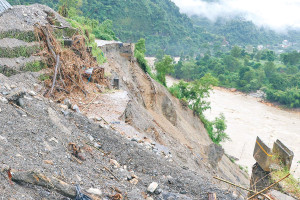
The scale of the wider disaster has made the local governments’ predicament more serious. The Bhotekoshi flood struck Rasuwa on Wednesday morning and then moved downstream through the Bhotekoshi and Trishuli rivers, sweeping away homes, roads, bridges and other infrastructure. By Saturday evening, police had reported 669 deaths across eight affected districts, with hundreds still missing.
Among the 15 local units declared disaster-hit by the government, Gosaikunda, Uttargaya and Kalika rural municipalities in Rasuwa, and Bidur and Belkotgadhi municipalities in Nuwakot, have suffered the heaviest human and physical losses.
The affected local governments said the damage had made it difficult to collect information on losses, arrange safe accommodation for displaced people and distribute relief. The disruption of roads, electricity and telephone services has further hampered coordination, they said.
The secretariat of Minister for Land Management, Cooperatives and Federal Affairs and General Administration Pratibha Rawal said 10 local-level employees, one rural municipality vice-chair, two ward chairpersons and two ward members were out of contact following the floods.
The Local Government Operation Act 2017 requires local governments to prepare disaster preparedness and response plans, identify and map areas at risk, take steps to protect and relocate vulnerable settlements, coordinate search, rescue and relief operations, maintain disaster-related data, and work with the federal and provincial governments, local communities, non-governmental organisations and the private sector.
With several local governments themselves severely impacted, the loss of personnel, records and basic infrastructure has made it harder for them to carry out these responsibilities.
Laxmi Pandey, chair of the National Federation of Rural Municipalities, said the federation was contacting representatives of affected municipalities and discussing how other local governments could help.
“The first priority should be to restore electricity and telephone services in the affected rural municipalities,” said Pandey. “Once communication is restored, it will be easier to contact them and provide support.”
Federalism expert Khimlal Devkota said the affected municipalities could not be expected to manage a disaster of this scale alone. “Federal and provincial governments, political parties and organisations all need to be involved,” he stressed.




 18.94°C Kathmandu