Saudi Arabia halts visas for Nepali workers needing skill certificates after Nepal seals testing centre
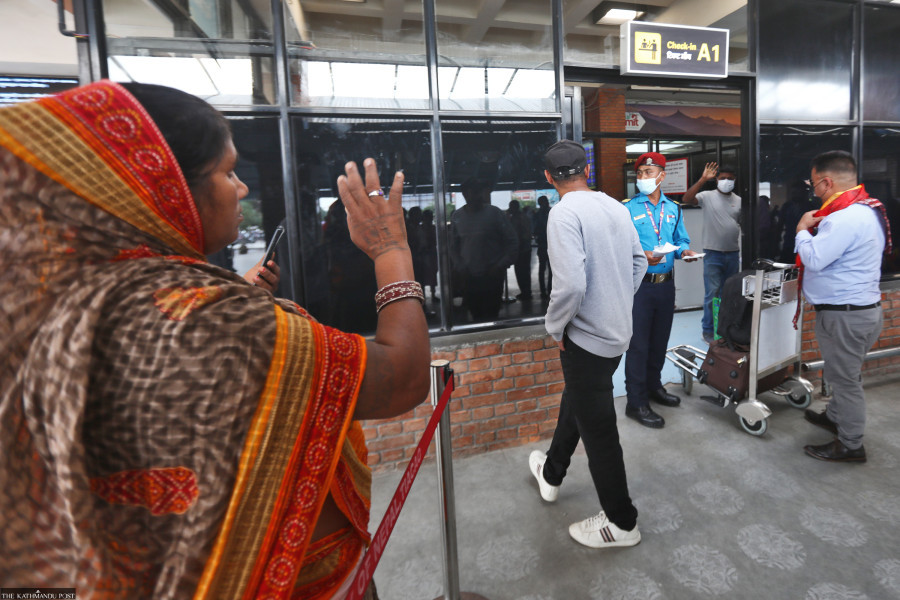
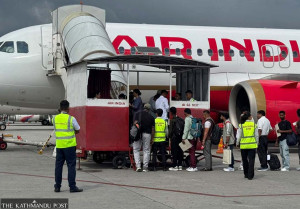
Processing has stopped for five job categories after Nepal sealed a private firm conducting Saudi-mandated skill tests. A mother sees off her son, going to Saudi Arabia to work as a driver, at the Tribhuvan International Airport, Kathmandu in this undated photo. Sanjog Manandhar/TKP Post file photo
Saudi Arabia has stopped issuing work visas to Nepali workers in five job categories that require mandatory skill verification certificates after Nepal’s government sealed the Kathmandu-based institute conducting the tests.
The Saudi Arabian embassy suspended visa processing for workers requiring Skill Verification Programme (SVP) certification after authorities sealed the Industrial Training Institute in Basundhara last Wednesday, saying the centre did not have legal authorisation to conduct skill assessments.
The shutdown has created uncertainty for thousands of Nepali migrant workers seeking jobs in Saudi Arabia, one of Nepal’s largest labour destinations.
Mahesh Kumar Basnet, senior vice-president of the Nepal Association of Foreign Employment Agencies, said visas were still being issued for workers in jobs that do not require SVP certification.
“We have asked recruitment agencies not to submit visa applications for jobs where Saudi Arabia has made skill verification certificates mandatory,” Basnet told Kantipur after meeting Saudi diplomatic officials on Tuesday. “A private institution has created a monopoly in the name of skill testing, piling financial burden on workers. This is unacceptable.”
Saudi Arabia has required skill verification certificates for Nepali workers going for jobs such as loading and unloading goods, portering, cart operation and construction work.
Workers are required to pay a $50 examination fee, equivalent to around Rs7,500. However, there is no legal provision allowing workers or recruitment agencies to directly pay the fee. Instead, Sai Vision Pvt Ltd has been collecting Rs10,000, including service charges, for arranging the process.
A $50 charge has been for recognition of prior learning (RPL), but the details of how the RPL system will work remain unclear.
The Ministry of Youth, Labour and Employment said it was holding discussions with Saudi authorities to resolve the dispute.
“The labour minister has been in talks with the Saudi ambassador,” said Pitambar Ghimire, spokesperson for the ministry. “A diplomatic note has also been sent.”
Saudi officials have expressed concern that Nepal has effectively suspended the SVP programme. Nepal’s labour officials, however, say the programme itself has not been stopped. They argue that the institute conducting the assessments did not have the authority to do so.
Nepal says skill testing should be conducted through a mutually agreed mechanism that protects workers’ interests.
“The process should be based on a bilateral agreement. Skill tests should be limited to occupations where workers’ abilities can be properly assessed, rather than being imposed on ordinary labourers. The government must also ensure that workers are not forced to bear the cost,” a labour ministry official said.
A labour agreement signed between Nepal and Saudi Arabia in January states that recruitment-related issues will be decided by a joint technical committee between the two countries. However, no bilateral agreement has been reached on introducing a skill certification programme.
Saudi Arabia’s Ministry of Human Resources and Social Development says the SVP was introduced to verify professional qualifications before issuing employment visas.
Saudi Arabia received around 77,000 Nepali workers last year. Of them, 67 percent went on general labour visas, eight percent worked in the service sector and 12 percent went as drivers and machine operators.
Foreign employment agencies say experiences from India and Bangladesh show that workers ultimately bear the cost of such certification schemes.
“The testing fee is one burden. If workers fail, they have to repeat the process and this adds to the cost,” said Dik Bahadur Khatri, president of the Nepal Association of Foreign Employment Agencies.
Saudi Arabia had planned to implement the SVP system from June 17. The rollout was delayed after foreign employment agencies vandalised the training centre assigned to conduct the assessments.
According to a notice issued by the Saudi Embassy in Kathmandu, workers must first register online through Saudi Arabia’s Professional Accreditation Portal before taking the skill test. They must then pay the fee in US dollars.
Applicants must select their occupation from the list of eligible professions, choose an approved testing centre and pick an available examination date. The test lasts three hours, with results expected within 24 hours to one week.
Saudi Arabia allows workers up to three attempts to pass the assessment. Those who fail after three attempts become ineligible to travel to the kingdom for employment.
Saudi authorities have said the programme is being introduced across all labour source countries.
Hom Karki is a reporter with two decades experience covering migrant workers issues and the Nepali diaspora. He was previously based in the Gulf for Kantipur Daily.




 26.26°C Kathmandu