Two-day weekend boosts tourism across hill stations
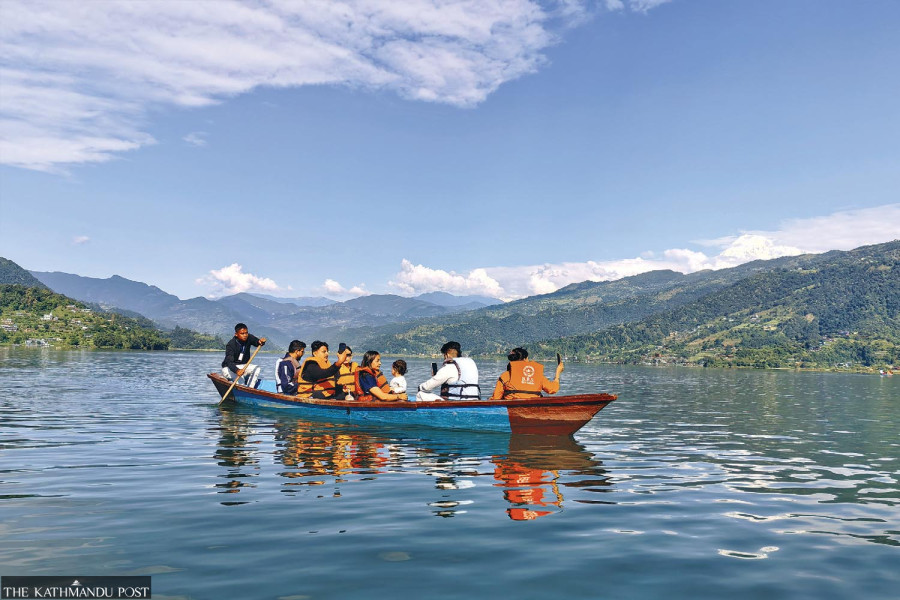
Introduced as an emergency measure to curb fuel consumption following the US-Israeli war on Iran, the new weekend policy has changed Nepalis’ travel habits and revitalised the country's hospitality sector. Nepali tourists boating on Phewa Lake, recently. Tourism entrepreneurs here say they are increasingly relying on domestic and Indian visitors. Mohan Guragain/TKP
The introduction of a two-day weekend by the government has transformed the weekly rhythm for Binayak Shah, president of Hotel Association Nepal (HAN). Nowadays, whenever Shah picks up his phone or meets acquaintances, a familiar question greets him: “Where is the best place near Kathmandu to take the family for a drive? Which hotels and resorts are ideal?”
Shah gladly guides callers through options for weekend getaways. “Many people ask where they should go with their families and which hotels are good,” Shah recently shared with Kantipur, reflecting on his evolving role. “Lately, my job has practically become advising friends and acquaintances about tourist destinations."
Initially introduced in April by the Rastriya Swatantra Party-led government to tackle a fuel crisis triggered by the US-Israeli war on Iran, the policy was primarily aimed at curbing fuel consumption. Yet, its most visible positive impact has been on the country’s tourism industry. At tourism and hotel gatherings across Kathmandu, business owners now express widespread enthusiasm about how the two-day break is energising the private sector.
Before the Bhotekoshi floods on August 26, consecutive two-day weekends had noticeably accelerated domestic tourist footfall in tourist hubs, hill stations, and resorts around the Kathmandu Valley. Subsequent flooding along the Budigandaki river in Gorkha on October 11 caused further disruption.
Although natural disasters and resulting damage to highways caused temporary setbacks, tourism entrepreneurs remain optimistic. “Primarily, we are hopeful that domestic tourism in hill stations around Kathmandu will continue to grow rapidly,” said Ram Sundar Bake, president of Hotel Association Nepal, Bagmati Province.
Prior to the Covid pandemic, a common perception dictated that five-star hotels and large resorts in Nepal existed exclusively for foreign tourists. However, travel habits among Nepalis have undergone a profound shift since the pandemic.
According to HAN President Shah, Nepalis now account for 60 to 70 percent of diners at Kathmandu’s five-star hotel restaurants, with foreign tourists making up the remainder.
“This is a major transformation in Nepal’s tourism sector following the pandemic,” said Shah, who also operates the Airport Hotel near Tribhuvan International Airport in Kathmandu. “Large hotels, restaurants, and banquet venues now rely primarily on domestic patrons” He said even households with ample space often prefer hosting celebrations and feasts at banquets or star hotels, leaving food, decoration, and event management to hospitality professionals so that they and their guests can enjoy the occasion without the hassle of organising themselves.
A similar trend is visible in Pokhara. Tourism entrepreneurs there, who once focused almost exclusively on foreign travelers while largely overlooking domestic and Indian visitors, now rely increasingly on local and regional tourists.
HAN’s analysis indicates that the two-day weekend has drawn large numbers of domestic tourists to Pokhara, as well as destinations like Dhulikhel and Nagarkot around the Kathmandu Valley. Shah notes a sharp rise in couples aged 25 to 45 from the corporate sector, middle-class families with school-aged children, and groups of friends setting out in private vehicles to spend weekend getaways.
Amita Shrestha, sales and marketing manager at Mystic Mountain Resort in Nagarkot, said the two-day weekend has proved highly effective in promoting domestic tourism. “Previously, when holidays were limited to Saturdays, guests found it difficult to coordinate schedules on a half-day Friday,” Shrestha explained. “With consecutive holidays on Saturday and Sunday, people began shifting their check-in days to Saturday.”
She added that the hassle of rushing out after a half-day at work on Friday vanished. Instead guests could arrive at their leisure on Saturday and return comfortably on Sunday. As a result, weekend bookings have risen to 40 and 50 percent.
Despite occasional disruptions caused by floods, Shrestha views the policy as highly beneficial for domestic tourism.
Mystic Mountain Resort, which has 72 rooms and can accommodate around 168 guests, enjoys strong weekend occupancy from Nepali families, while MICE (meeting, incentive, conference and exhibition) tourism and Non-Resident Nepali (NRN) guests help sustain business during the week.
Bake, who also owns Highland Resort in Ranikot, describes the two-day weekend decision as a boon for the tourism industry. He said hotel activity previously peaked briefly on Saturday after a modest turnout on Friday, but now, hotels and resorts remain fully booked across both Friday and Saturday nights.
“With two days of leisure each week, people are easily traveling beyond destinations close to the Kathmandu Valley to spend one or two nights in Sindhuli’s Mulkot area, Bandipur, Gorkha, and Nuwakot,” said Bake. This shift has fostered rural tourism and significantly boosted destination promotion.
To further energise and organise domestic tourism, the Bagmati Province chapter of HAN is preparing to host a grand Bagmati Province Tourism Fair from January 1 to 3. The event will feature local food competitions, municipal destination profiling, and hotel promotions.
Located roughly 11 kilometres from Sundarijal in Kathmandu, Prakriti Resort and Organic Farm in Haibung in Sindhupalchok has emerged as a tranquil retreat for domestic travelers. According to founder and managing director Arun Shrestha, the number of domestic tourists and weekend hikers visiting the property has risen by up to 50 percent due to the two-day weekend.
Spanning 150 ropani (7.6 hectares) and featuring an organic and permaculture farm, the resort offers more than a lodging facility; it also serves as a hands-on learning center. Guests can learn about organic farming and permaculture and experience an eco-friendly lifestyle firsthand. Situated in the heart of the Shivpuri National Park and away from excessive commercialisation, the resort prioritises local culture, indigenous cuisine, and traditional architecture.
Shrestha said visitors taking a break from their routines immerse themselves in local biodiversity, medicinal herbs, birdsong, and fresh air. Guests can reach the resort via a four-hour trek from Sundarijal or by driving to Mulkharka followed by a two-hour hike. The nearby Dhap Pond, sweeping views of the Kathmandu Valley, the Chisapani hiking trail, and religious sites offer guests distinct mental peace and rejuvenation, he noted. With 20 rooms accommodating about 40 guests, the resort avoids overcrowding by following a ‘low volume, high experience’ model. It caters to middle-class Nepali families on modest budgets ranging from Rs5,000 to Rs7,500 per person.
Rajaram Silwal, operator of the two-star Hotel Janajibika in Dhading district headquarters, said travellers often venture beyond the Kathmandu Valley to Dhading for two-day weekends or extended holidays alike.
The two-day policy has increased visitor numbers and dining traffic among families exploring Dhadingbesi and the highway corridor, said Silwal. Besides business travelers and commuters on the Kathmandu-Dhading route, more people are visiting specifically to relax with their families over the weekend.
Although the two-day weekend has benefited the tourism industry broadly, Dhulikhel has yet to experience its full impact. Lina Khadka, CEO of Dhulikhel Mountain Resort, said prolonged delays in the Bhaktapur-Suryabinayak-Dhulikhel road project, compounded by recent floods and landslides, have created challenges for the Dhulikhel area.
Describing the two-day weekend concept as commendable, Khadka said, “Following the initial surge of excitement, arrivals to Dhulikhel have dipped somewhat due to weather and road conditions.” Nevertheless, corporate meetings, training sessions, and weekend getaways continue to draw domestic visitors to Dhulikhel.
HAN says the extended weekend policy's greatest achievements include fostering a travel culture among Nepalis, promoting lesser-known domestic destinations, and energising local economies, from farmers to transport operators to hotels.
According to HAN president Shah, if institutions like the central bank, corporate bodies, and the government systematically implement ‘leave and travel allowances’ or domestic exploration programmes for their employees, alongside timely road infrastructure upgrades, the two-day weekend framework could take domestic tourism to new heights.
Suraj Kunwar is a senior correspondent with over two decades experience covering Aviation, Tourism and Mountaineering. He received the IFJ Tolerance Award in 2005.




 13.27°C Kathmandu