



 18.11°C Kathmandu


Sun, Oct 25, 2026
Columns
Who pays for Nepal’s informal workers’ security?
Nearly nine in ten Nepali workers are informal, yet the system built to protect them barely reaches them. Registration alone won’t fix that.
bookmark
Roshee Lamichhane & Kingsuk Sarkar
Published at : October 25, 2026
Updated at : October 25, 2026 03:38
In December 2025, the International Labour Organisation (ILO) reported that over 86 percent of Nepal’s workers were in informal employment. Yet, out of nearly 2.7 million workers registered with the Social Security Fund (SSF), only about 1,500 were informal or self-employed.
But Nepal is not an exception. About 58 percent of the world’s workers are informally employed. Informal workers often lack access to labour law and social protection. The distinction matters: the 2017-18 Labour Force Survey found 84.6 percent of Nepal’s employed in informal employment. Informal jobs also exist in registered firms in Nepal, where about 78 percent of workers held informal jobs in 2018. Registering businesses, however, is not the same as protecting workers.
Informal workers are hard to reach
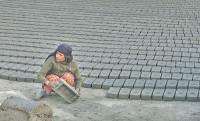
Labour is a pillar of any economy, so workers’ wellbeing matters to every government. Formal-sector employees enjoy contracts, provident funds and insurance. Protecting informal workers is far harder. They change occupation and location often, work seasonally or hold several jobs at once. The construction industry, which employs one in seven Nepali workers, was 98.2 percent informal as of 2023. Due to temporary contracts, changing work locations, and subcontracting, it is difficult to enrol workers into the system and collect payments. In brick kilns, whole families migrate seasonally, often through labour contractors, in an industry that is predominantly manual and generally runs from November to May. The need for protection stays constant while employer, worksite and income change.
Consider a construction labourer who moves from one building project to another. The worker’s need for accident protection and income security remains constant, but the employer, worksite and wage-payment arrangement may change repeatedly. The ILO identifies precisely these features such as temporary employment, mobility and subcontracting as barriers to social-security coverage in Nepal’s construction sector. This is why portability matters. Contribution records and benefits should follow workers across employers and projects. Many have an employer, but lack a stable, documented or enforceable employment relationship.
In Nepal’s brick industry, the unit of vulnerability is often the family rather than the individual worker. ILO–UNICEF research estimated that 34,593 children aged five to 17 were living in kilns. Their movement creates challenges not only for employment protection but also for continuity in children’s education. A protection system tied rigidly to a permanent address or a single employer risks missing the realities of such households.
Even for willing governments, one of the major problems is reliable information. Banerjee and co-authors note that a large informal sector complicates identifying who should be protected. Article 34 of Nepal’s Constitution and the Contributory Social Security Act, 2017, provide the legal footing. Since 2023, a Social Security Fund (SSF) operating procedure has let informal and self-employed workers enrol voluntarily, with a government co-contribution, and in December 2025 the SSF, the labour ministry and the ILO launched a national campaign.
Yet an agreement on paper is not coverage. By December 2025, 114 local governments had signed agreements with the SSF, but only six had enrolled workers. Uncertainty over who pays the government’s share was a principal bottleneck. Affordability matters: 41.9 percent of informal wage workers earned below the minimum-wage benchmark, against 6.9 percent of formal wage workers. Registration needs affordable contributions, reliable public co-financing and payment arrangements suited to irregular incomes.
Lessons from India
Nepal’s southern neighbour has tried a different entry point: identify workers first, protect them second. With a population exceeding 1.4 billion, India faces a challenge similar to Nepal’s in extending social protection to millions of workers outside formal employment. India brought the Code on Social Security, 2020, into effect on 21 November 2025, which is expected to address these issues to a large extent. Back in August 2021, India launched the e-Shram portal to create a national database of unorganised workers and facilitate their access to social security schemes. It is now considered the world’s largest database of such workers.
The Code on Social Security, 2020, provides the legal basis for extending social security coverage to unorganised, gig and platform workers. It envisages schemes covering areas such as life and disability cover, health and maternity benefits, and old-age protection. However, the extent of protection depends on the schemes notified, their implementation and the resources allocated. One of the key strengths of e-Shram is its potential to address the information gap between the government and informal workers. Registration provides workers with a Universal Account Number (UAN) linked to Aadhaar: the country’s national biometric digital identity system, helping identify them and facilitate access to relevant welfare schemes. By October 15, 2026, the portal had enlisted over 320 million workers, proving its capacity for large-scale outreach.
But registration does not necessarily translate to social security. There can be challenges in understanding the criteria for eligibility, navigating administrative requirements and accessing benefits. Moreover, the effectiveness of such a system depends on regularly updating worker records, ensuring the actual delivery of benefits, adequate funding and coordination among government agencies. India’s experience highlights the distinction between identifying informal workers and ensuring their effective social protection.
Nepal can draw three important lessons from India. First, there should be an attempt to create a well-maintained database that covers all informal workers, connected to social security programmes that already exist. Second, registration should be easy and free and done through the local governments, cooperatives, and worker unions, in addition to online mechanisms. Lastly, there should be provision for continued access to benefits despite changes in occupations and locations of informal workers.
Ultimately, Nepal should not measure success merely by the number of workers registered. The real measure is how many previously excluded workers receive meaningful protection against illness, workplace injuries, income loss and old-age insecurity. India offers Nepal a useful starting point, but the priority must be turning registration into reliable, inclusive and sustainable social protection. Nepal’s social-protection system should be designed around the real, variable and often precarious forms of work that most Nepalis perform, not around the standard full-time, employer-mediated salaried job. Nepal should strengthen contributory social insurance but cannot rely on it alone. A realistic strategy combines a subsidised protection floor for health, maternity, disability, old age and income shocks; flexible contributions with holidays, arrears management and income-linked rates. It also relies on public co-financing for low-income workers, especially women, and portable administration through digital ID, local governments, cooperatives and worker organisations.
Roshee Lamichhane
Lamichhane is an associate professor at the Kathmandu University School of Management, Lalitpur. She holds a PhD in marketing (consumer behaviour).
Kingsuk Sarkar
Sarkar is an associate professor of management at the National Institute of Technology, Manipur.




Most Read from Columns

Editor's Picks



E-PAPER | October 25, 2026

×