KU info lab leads efforts to digitise and preserve Nepal’s indigenous languages
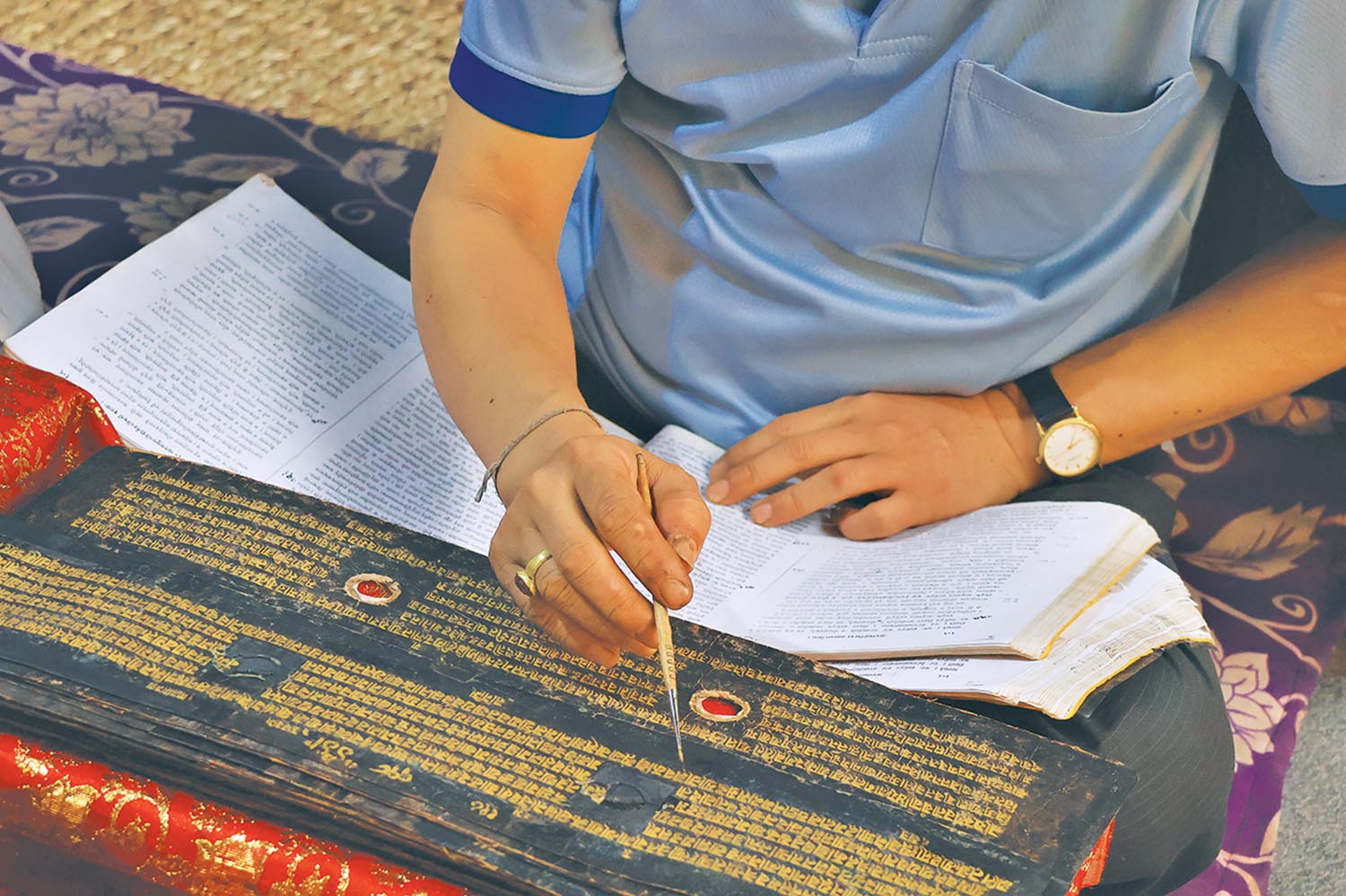
From digitising centuries-old manuscripts to training AI models, researchers and language communities are using technology to preserve Nepal’s linguistic heritage.A concerted effort is being made to preserve multiple Nepali languages and their scripts. Courtesy of Archieve Nepal
Communities and academics in Nepal are stepping up their efforts to put the country’s indigenous languages on the digital scene, aided by artificial intelligence that has emerged as an important tool for preserving languages and passing them on to the younger generation.
A major step comes from the Kathmandu University’s Information and Language Processing Research Lab, which recently unveiled a trilingual translation system covering Nepali, Tamang and English.
The system, supported by a Google Academic Research Award, was trained on more than 100,000 parallel sentences in Nepali, Tamang and English. Researchers used artificial intelligence and trained Meta AI’s NLLB-200 model on datasets in Nepali and Tamang.
Professor Bal Krishna Bal, lead researcher at the lab, said most of the information Nepali speakers find online is available either in English or Nepali. He believes the trilingual machine translation system can help Tamang speakers access the vast body of knowledge available online while allowing their culture and traditions to reach wider audiences.
“English has become so dominant that we find it increasingly difficult to write and speak even in Nepali. The language faces ever more encroachment,” Bal said.
“But among Nepalis living abroad, there seems to be a stronger emphasis on preserving their mother tongue. They want their children to learn cultural and family traditions, including customs and rules surrounding marriage.”
The usefulness of translation technology is broad, both inside Nepal and among Nepali communities abroad, Bal added.
Amrit Yonjan, coordinator of the Tamang translation team, said that the technology had given fresh hope to efforts to preserve Nepal’s indigenous languages. He added that the team was also working to have Tamang added to Google Translate by mid-March 2027.
“Google sent us some sentences in English. We translated them into Tamang and submitted them. They said they would integrate them into Google Translate,” Bal said.
“Before adding a new language, Google requires its own designated English-language corpus to be translated into the target language. We will soon complete that work and submit it.”
Nepali, Maithili and Nepal Bhasha, also known as Newari, are currently the only three languages from Nepal available on Google Translate.
The progress with Tamang has encouraged other linguistic communities to pursue similar projects. Magar, Sherpa and Tharu communities are among those showing interest in bringing their languages into AI systems.
The Magar and Tharu communities have already expressed their interest in formally working with Kathmandu University’s language research lab. The Magar community has pledged to provide more than 25,000 sentences and words to help researchers train an AI model.
Bishnu Kumar Sinjali, an activist involved in indigenous language and cultural studies, said the decline of his mother tongue was a serious concern.
Of Nepal’s estimated two million Magars, around 1.1 million have stopped speaking their mother tongue, he said.
“Technology has become essential to teaching the mother tongue to younger generations and ensuring its continuity,” Sinjali said.
“When languages are built into technology, it makes it easier for the government to provide services and conduct official business [in them]. Machines can make these processes more efficient without requiring too many personnel.”
For the transmission of linguistic knowledge from one generation to the next, embracing digital technology has become a necessity, he stressed.
Nepal’s constitution recognises Nepali, written in the Devanagari script, as the official language for federal government business under Article 7. Provinces can designate other mother tongues as official languages based on recommendations from the Language Commission.
The Koshi provincial government recently decided to move ahead with legislation to recognise Limbu and Maithili as languages for official business.
Among Nepal’s indigenous languages, Nepal Bhasha has made the most systematic progress in the digital sphere.
The language’s historic Ranjana and Prachalit scripts have been standardised in Unicode. Users can now access mobile keyboards, digital dictionaries, Google Translate and optical character recognition tools that can identify characters in historical inscriptions.
The Kathmandu Metropolitan City has also been active in supporting such efforts, including providing financial assistance to young people working on language digitisation. Acting mayor Sunita Dangol has herself been involved in promoting the digital use of the Ranjana script.
Another project, Newa ASR, led by young engineer Swarnim Nakarmi, is working to keep Nepal Bhasha alive through AI.
The automatic speech recognition project aims to develop systems capable of understanding and speaking Nepal Bhasha, including speech recognition and text-to-speech functions.
Hundreds of voice samples have so far been collected through community participation, Nakarmi said.
“We have collected a wide range of voice samples from native Nepal Bhasha speakers from different regions and linguistic backgrounds,” he said. “The samples are processed and used to train a deep-learning model based on the phonetics and grammar of Nepal Bhasha. Our goal is to collect as many voice samples as possible to make the model more accurate and mature.”
Once completed, the technology will allow computers and other digital devices to understand Nepal Bhasha and accurately convert spoken language into written text. It will also be able to convert the Nepal Bhasha script into speech.
Kathmandu metropolis has also been recognised for its efforts to preserve local languages.
Aided by the municipal government, a Nepal Bhasha Dictionary app has been launched in coordination with cultural scholar Mall K Sundar and Asmeet Malla, a team member. According to city spokesperson Nabin Manandhar, the app contains more than 41,000 words and their meanings. It also allows Romanised Nepali to be converted into Newa script.
“Language preservation cannot have a strong foundation if technology is ignored. People no longer have much time to sit down and read books,” Manandhar said
“The metropolis invested in creating an environment where people can find a word with a single click on their mobile phone. If needed, the City will also support Tamang and other indigenous languages spoken in Kathmandu.”
Nepal Bhasha is ahead of other indigenous languages in terms of efforts to promote its script.
Kathmandu University and Kathmandu Metropolitan City have also worked together on an AI-based project to digitally archive ancient historical heritage sites in the Valley.
According to Professor Bal, researchers are developing technology that can photograph inscriptions whose characters are gradually being eroded by exposure to sunlight, rain and wind and convert them into digital text.
“We have developed a model that can photograph the inscriptions and convert their characters into digital text,” Bal said. “This is an important area of research from a historical and cultural perspective. But for now, it remains at the research stage. We have prepared the datasets and model, but it has yet to be released as an application or website.”
Nakarmi also worked on the project from September 5 to 6.
The push to bring Nepal’s languages into the digital world comes amid growing international concern over the lack of technological support for many of the world’s languages.
Last year, UNESCO released its report, “Global Roadmap for Multilingualism in the Digital Era: Advancing the Role of Language Technologies”, which called for inclusive language technologies, data sovereignty and community-led decision-making to help preserve mother tongues.
The UN agency has also set out strategies to ensure universal access to machine translation and language technologies across language communities and to support the digital transformation and promotion of endangered, indigenous, sign and haptic languages.
UNESCO has also been supporting young developers, startups and language advocates in Nepal through grants and other assistance as part of its strategy to promote multilingualism in the digital age.
One such initiative is Archive Nepal, which is working to preserve handwritten Nepal Bhasha manuscripts. With UNESCO’s support, the organisation has digitised more than 3,300 pages of old Nepal Bhasha manuscripts, said Saroja Hakuduwal, its operations manager. Young volunteers have transcribed and translated the manuscripts and uploaded them to Wikisource.
“Between November 2025 and August 2026, we digitised more than 30 rare Nepal Bhasha manuscripts that are between 200 and 800 years old,” Hakuduwal said. “With the help of volunteers, we are transcribing the manuscripts into digital text and translating them into Nepali and English so they are accessible to the public. The materials are freely available on Wikisource and Archive Nepal’s digital platform.”
Archive Nepal has also organised four “Transcribathon” events to teach people how to read the Ranjana, Prachalit and Bhujimol scripts and type them using Unicode. More than 50 volunteers from different generations have taken part.
For some young participants, it was their first opportunity to learn to read and type their own traditional script, Hakuduwal said.
“At our fourth Transcribathon event, we brought together AI developers working on Nepal Bhasha speech recognition technology and visual artists to demonstrate how modern technology and art can be combined to preserve traditional cultural heritage,” she said. “We now plan to digitise old materials in other languages as well. We are studying whether ancient and historical manuscripts kept in Tibetan monasteries can also be digitised.”
To understand how these efforts to preserve mother tongues through technology have evolved, it is worth looking back at Nepal’s history of language digitisation.
Writer Kedar Sharma, who played a leading role in promoting Unicode to make Nepali easier to use on computers and the internet, says technology has opened new possibilities for indigenous languages that once struggled even to gain a foothold in the digital world.
In the early days, he said, bringing languages into digital technology was expensive and difficult.
“When the Madan Puraskar Pustakalaya was developing a Unicode keyboard, computers and other tools were extremely expensive, consumed a lot of electricity, and mobile phones had not yet arrived,” Sharma recalled. “The biggest obstacle, however, was the language itself. People who did not know English could barely use a computer. When Android technology came to Nepal, it gave indigenous languages a new lease of life.”
The spread of Android and social media created new opportunities for people to write and express themselves in their own languages, Sharma said. He finds that important not only for language preservation but also for social progress and dignity.
The disappearance of a language, he said, means far more than the loss of words. It can also erase generations of knowledge and local traditions embedded in that language.
“Traditional knowledge held by older people, such as identifying and eating different plants and preparing food using resources from villages and forests, can disappear along with a language,” Sharma said. “Digital preservation of languages is therefore crucial for passing on the knowledge our society has accumulated over thousands of years.”
He said some families are increasingly choosing to teach their children only Nepali and English, rather than their mother tongue, as they become more integrated into the linguistic mainstream.
AI for Nepal’s languages
Himalaya AI Labs is also working to build a local AI ecosystem, with a focus on Nepali and other low-resource languages that have relatively little content available online.
The organisation is developing Devanagari-focused datasets and foundation models for Nepali and other languages. It is also building benchmark tests to measure the accuracy and performance of AI models and developing datasets to improve Nepali-language processing, translation and output quality using open-source models.
Himalaya AI is working with international and Nepali researchers based abroad to secure computing and GPU infrastructure. It aims to develop a large language model focused on Nepali, with plans eventually to bring regional languages such as Rai, Limbu and Newari into AI systems.
Sharma believes technology could even help revive languages that are declining.
“I see strong potential for language revival,” he said. “Having the tools available and growing ethnic and cultural awareness within communities can make a huge difference.”
During the Panchayat era, he recalled, recording a song required access to Radio Nepal or Ratna Recording Studio because recording technology was limited and tightly controlled by the state.
“But once FM radio stations began operating and recording technology became more accessible, songs and creative works in Newari, Tamang, Kirat and other local tongues grew rapidly,” he said. “Once technology gives us the tools, the responsibility to use them and take them forward rests with the people who speak that language.”
Government efforts lag
While communities, researchers and technology groups are moving ahead, the government’s response remains slower.
The Language Commission began work on a multilingual electronic dictionary in the fiscal year 2018-19, but the project has yet to be completed.
The commission has so far entered words from 30 languages into its digital dictionary, said spokesperson Kamala Bhandari Pandey.
“The commission has developed multilingual electronic dictionary software that allows words to be easily interpreted from one language to another,” the commission said in its seventh annual report. “In addition, around 6,200 Nepali words have been entered and linked, wherever possible, to entries in each language.”
The software already contains vocabulary from languages including Athpahariya, Uranw, Chamling, Chhantyal, Darai, Bote, Bajjika, Yakkha, Lungkhim, Santhali, Sampang, Belhare, Kathariya Tharu, Done, Jumli, Thulung, Limbu, Tajpuriya, Kshetteli, Tilung, Dangaura Tharu, and Raute.
But a lack of funding has stalled further development, Pandey said.
“Because of budget constraints, we have not been able to further improve the software, and it is still not open to the general public,” she said. “The government’s practice of slashing the budget each year and failing to prioritise language preservation has slowed these efforts.”
Linguists and language activists are critical of the government’s slow pace.
With AI developing at such speed, they say there is little time to waste if indigenous languages are to remain relevant in the digital world. Languages unable to keep pace with new technologies face the threat of gradual extinction.
“Ultimately, the government needs to take ownership of this work and support it to make it sustainable,” Bal said. “Local and provincial governments, in particular, have an important role to play.”




 12.62°C Kathmandu