UN experts urge India to stop excessive force against youth protesters
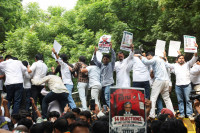
Experts cite alleged arbitrary detentions, police violence and gender-based abuse as they call for independent investigations into the handling of protests over education policies and voter-roll deletions. Supporters of India’s main opposition Congress party attend a protest demanding the resignation of India’s Chief Election Commissioner Gyanesh Kumar in New Delhi, India, September 25, 2026. Reuters
United Nations experts have urged Indian authorities to end the use of excessive force against peaceful protesters, lift blanket bans on public gatherings and investigate alleged human rights violations during recent demonstrations.
In a statement on Tuesday, the experts expressed alarm over what they described as a repeated heavy-handed police response to youth-led demonstrations in New Delhi and other parts of India over the past three months.
They called on the authorities to respect and protect the right to peaceful protest and ensure justice for human rights violations reported during recent and previous demonstrations.
“This crackdown reflects a broader, troubling pattern,” the experts said, citing previous concerns over restrictions on peaceful assembly, excessive use of force, arbitrary detentions, enforced disappearances and the targeting of student activists.
Hundreds of thousands of students and their supporters have gathered peacefully in different parts of India in recent months to protest government decisions on the education system. More recently, demonstrations have also focused on voter-roll deletions affecting 130 million individuals, reportedly including members of the Muslim minority and Scheduled Castes and Tribes.
Despite the peaceful nature of the demonstrations, law enforcement agencies have reportedly used force against unarmed students, including baton charges, and prevented thousands of people from joining the protests, the experts said.
They added that more than 7,000 youths, journalists, human rights defenders, lawyers and members of political parties had recently been arbitrarily detained in New Delhi and taken to remote detention centres. Their phones were allegedly seized and protest-related material deleted.
Most of those detained, including protest leaders, were released 24 hours later, according to the statement.
The experts said they had received reports of injuries and ill-treatment among protesters. They also expressed particular concern over allegations of sexual violence and other forms of gender-based abuse during demonstrations and related detentions.
They further raised concerns over the reported use of Section 163 of the Bharatiya Nagarik Suraksha Sanhita, India’s criminal procedure code, to impose broad bans on public gatherings, suspend public transportation and shut down internet services.
“These actions violate India’s core international legal obligations, including the rights to freedom of peaceful assembly, freedom of expression, liberty, security of the person, and the right to defend human rights,” the experts said.
They stressed that any restrictions on peaceful assembly must have a legal basis, pursue a legitimate aim and be necessary and proportionate.
The experts urged the authorities to immediately stop using excessive force, lift blanket bans on public gatherings and refrain from misusing digital surveillance, including biometric technologies, and disrupting internet services.
They also called for an independent, impartial and thorough investigation into the conduct of law enforcement agencies and affiliated forces, saying it should begin without delay to ensure accountability, justice and reparations for victims.
“The Government must guarantee non-recurrence and uphold the democratic right of students and others to assemble and express grievances,” they said, adding that particular attention should be paid to the gender-specific effects of restrictions on peaceful assembly and reprisals against protesters.
The statement also referred to an incident in March, when 10 student and labour-rights activists were reportedly detained in New Delhi by plain-clothes police officers. They were held incommunicado for more than 24 hours and allegedly subjected to ill-treatment, threats, coercion and forced declarations before being released following habeas corpus proceedings.




 19.11°C Kathmandu