



 14.71°C Kathmandu

Tue, Oct 20, 2026
Opinion
The tiger and the farmer
In his memoir The Soul of the Rhino, the pioneer conservationist Hemanta Mishra describes his first sighting of rhinos in the wild: “Ugly and vicious, yet…they radiated an undeniable appeal.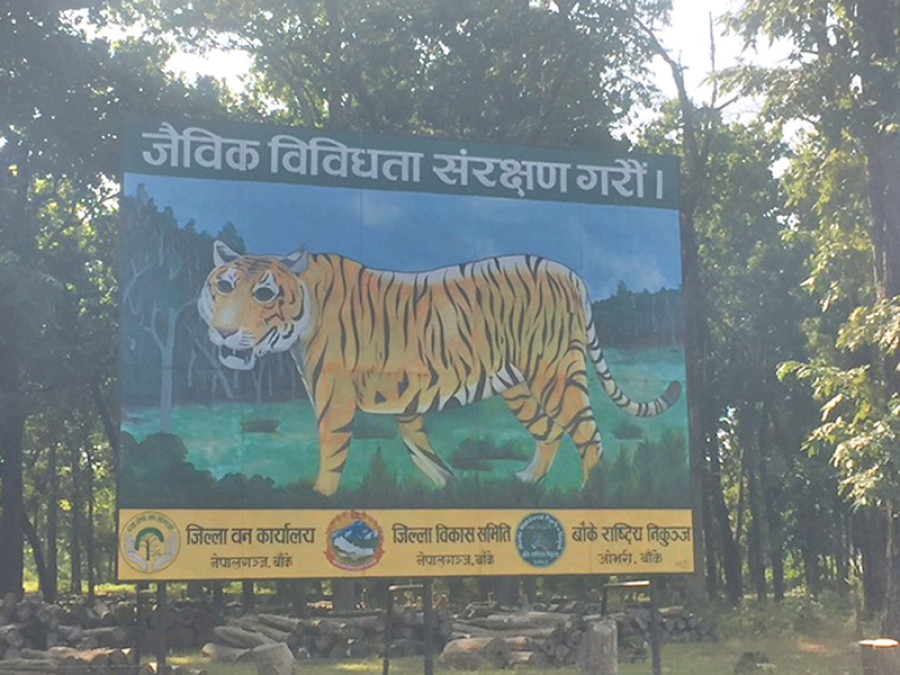
bookmark
Shradha Ghale
Published at : April 10, 2018
Updated at : April 10, 2018 09:36
In his memoir The Soul of the Rhino, the pioneer conservationist Hemanta Mishra describes his first sighting of rhinos in the wild: “Ugly and vicious, yet…they radiated an undeniable appeal. Grotesque, yet elegant…Clumsy and misshapen, yet lithe and graceful. Their sight frightened me, but I could not turn away. I was spellbound.”
Anyone who has sighted rare wildlife during a jungle safari in Chitwan or elsewhere can probably relate to this feeling. For city dwellers looking to connect with the natural world, spotting an animal in the wild can evoke a whole range of aesthetic emotions (provided the creature is at a safe distance). One doesn’t need to be a conservationist, or even understand how wildlife contributes to ecological balance, to be able to appreciate the tiger, rhino, barking deer or dolphin.
Moreover, at a time when climate change and human activities threaten the planet’s diversity of life, few of us can debate the importance of wildlife conservation. Many of us rejoice when the government, conservation organisations and media bring us news about increased numbers of tigers, rhinos and other such glamorous species.
Unpleasant encounters
However, for a large number of Nepalis who live near protected areas, wildlife population growth has come at a great cost. Their encounters with wild animals are far from romantic.
About 35,712 people live in the buffer zone of Banke National Park, the youngest national park in Nepal. Ninety percent of them depend on agriculture. Since the park was established in 2010, wild animals have increasingly become the bane of their lives.
“This year I couldn’t harvest a single maize cob from my three kattha of land, wild boars ate everything,” said Anita Pariyar, a single mother who lives on public land in Balapur village of Rapti Sonari rural municipality. Many people in the village have stopped cultivating their land as wild animals destroy everything they grow. The worst hit are the poor and marginalised who are already struggling to make ends meet. In Sikta village, the entire community is demanding resettlement due to the wild boar menace. “The government should resettle us in a safe place away from the park,” said Manka Devi Pun. “We want to be in a place where wild animals won’t destroy our crops, where we are not barred from using forest resources.”
Different perspectives
What is often known as “park-people conflict” is essentially a tension between two perspectives. The dominant perspective is represented by those who lead conservation—government, national park authorities and big conservation INGOs. In this view, forests belong to wildlife, not people.
“The Tarai stretch belonged to the animals,” said a senior official at the Zoological Society of London, Nepal. “It is humans who encroached on their land. Animals attacked people because they felt threatened. In return humans are provided compensation.” Thus the current challenge is how to manage the large numbers of forest-dependent people in order to protect forests and ensure that wild animals, especially “flagship species” like the tiger, rhino and Asian elephant, are able to move freely, thrive and multiply. This view is propagated at the highest levels across the globe and receives substantial funding from bilateral and multilateral institutions.
A 2015 USAID newsletter describes how a community forest chairperson sees the problem of crop depredation in a conservation area: “…the loss of a few crops is a small price to pay for the value of having a healthy population of barking deer in his forest. Human-wildlife conflict—which can happen when people encroach on wildlife habitats, or in the case of Nepal, where conservation success leads to wildlife leaving their protected areas—can undermine conservation efforts because it leads to discontent in local communities over the presence of a protected area.”
“Discontent” sounds like a careful understatement of what people have had to suffer because of wildlife attacks.
Downplaying losses
In Bardiya National Park, wild elephants have terrorized the entire population of the buffer zone. Elephants come at night and raid people’s crops and sometimes damage their homes. Juna Karki, 26, is a single mother of two who lives in a small hut near the western boundary of the park. Her husband, a migrant worker, died in Qatar in unknown circumstances a few years ago. “It is lucky we are still alive,” she said. “Wild elephants have already destroyed our hut twice. My daughters are so terrified they can hardly sleep at night.” In September 2016 wild elephants killed two Tharu residents, a 72-year-old man and a 15-year-old schoolboy, on the same day. The elderly man was guarding the fields against elephants when he was attacked by one.
“We have to go to jail if we kill a bird, but we can’t harm an animal even when it attacks us,” said Min Raj Tharu, a buffer zone resident of Janaknagar village.
Several Dalit families in Madhuwan rural municipality were displaced as a result of elephant attacks. They are now living on public land in Kailasi village. Without land titles they can’t even claim compensation for the damage. Besides, the process of claiming compensation is so tedious and exhausting most people give up before they even complete the application process.
Unequal conflict
The term “human-wildlife conflict” is somewhat misleading as it projects the problem as an equal battle between local people and protected wildlife. But it is the people—poor, vulnerable, forest-dependent people—who are most often at the receiving end of this conflict.
As conservation organisations announce their success stories, the number of people killed by wildlife is rising. Last year “flagship species” such as tigers, rhinos and elephants killed 14 people and injured 30 in Chitwan National Park. As I write this, a tiger has killed a woman who was collecting fodder and injured two others near Parsa National Park in Makwanpur.
But the conservation industry often downplays the suffering of people who are paying the price of wildlife protection. Organisations that receive funding for wildlife protection routinely promote a narrative that obfuscates the lived reality of people in protected areas.
A community forest activist in Kathmandu nicely summed up the attitude of such organisations: “If the die-hard conservationist has to choose between the tiger and his son or daughter, whom will he choose? His child, of course. But he will have no qualms choosing the tiger over the poor Tharu farmer.”
Ghale, a former op-ed editor at the Kathmandu Post, is a freelance writer
Shradha Ghale
Ghale is a freelance writer and the author of the novel ‘The Wayward Daughter: A Kathmandu Story’ (2018).




Editor's Picks




E-PAPER | October 20, 2026

×