Why has the medical education sector not been reformed?
The defiance of medical college operators and the government’s failure to enforce the ceiling it has set for MBBS and BDS courses lead students to be overcharged, which is the cause of the prolonged agitation. Sanjog Manandhar/TKP
Other than politics, if there is any sector that has attracted huge public protests for reforms in the country, it is health. However, it remains among the shadiest areas in the country. Calls for reforming the sector started in 2010 after irregularities were found during an entrance examination for post-graduate courses at the Tribhuvan University Institute of Medicine in Maharajgunj. Following three weeks of joint protest by doctors and students and intervention by the Supreme Court, a committee was formed to probe the matter. The panel led by former education secretary Jay Ram Giri found that questions were leaked before the test and recommended action against the wrongdoers. Though Giri’s report was never implemented, the protest gave birth to a fighter, who is none other than Dr Govinda KC.
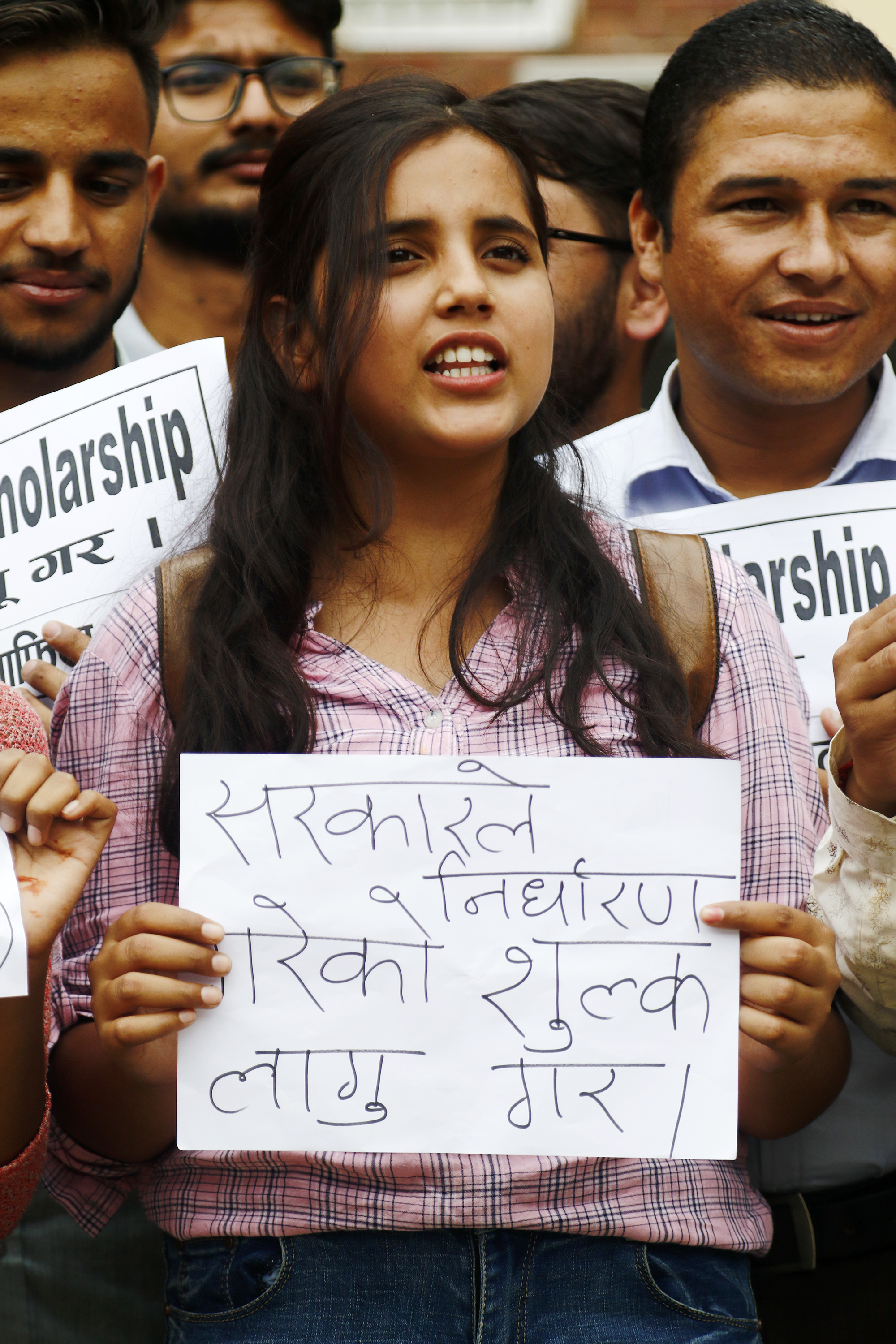
Nine years since the first protest to end the irregularities in medical education and rounds of agitation by Dr KC, who retired as a TU professor on Monday, the problem hasn’t stopped. Still today, medical students have been staging demonstrations demanding that private medical colleges abide by the government fee ceiling and refund the additional money they charged.
Here’s everything you should know about the country’s ailing medical education sector.
What is the problem?
The government determines the maximum fee ceiling for private medical colleges. However, that seldom gets implemented. The government in October last year set tuition fees for MBBS courses at Rs3.8 million for private colleges in Kathmandu Valley and Rs4.24 million for those outside the Valley. The fee is Rs 1.9 million for the BDS course. But different studies have shown that all private medical colleges have been breaching the government ceiling and charging up to Rs6 million for the MBBS course.
When the students who qualify through entrance tests approach the medical colleges for admission, they demand thousands of rupees higher than the government ceiling to admit one. The college operators threaten to admit somebody else if a candidate doesn’t pay the said amount, leaving the students with no options. Many medical colleges have even been found charging fees to the students selected under government scholarship quotas. It is mandatory for private medical colleges to provide education free of charge to 10 percent of the total MBBS quotas for the respective college.
Why are the students on agitation?
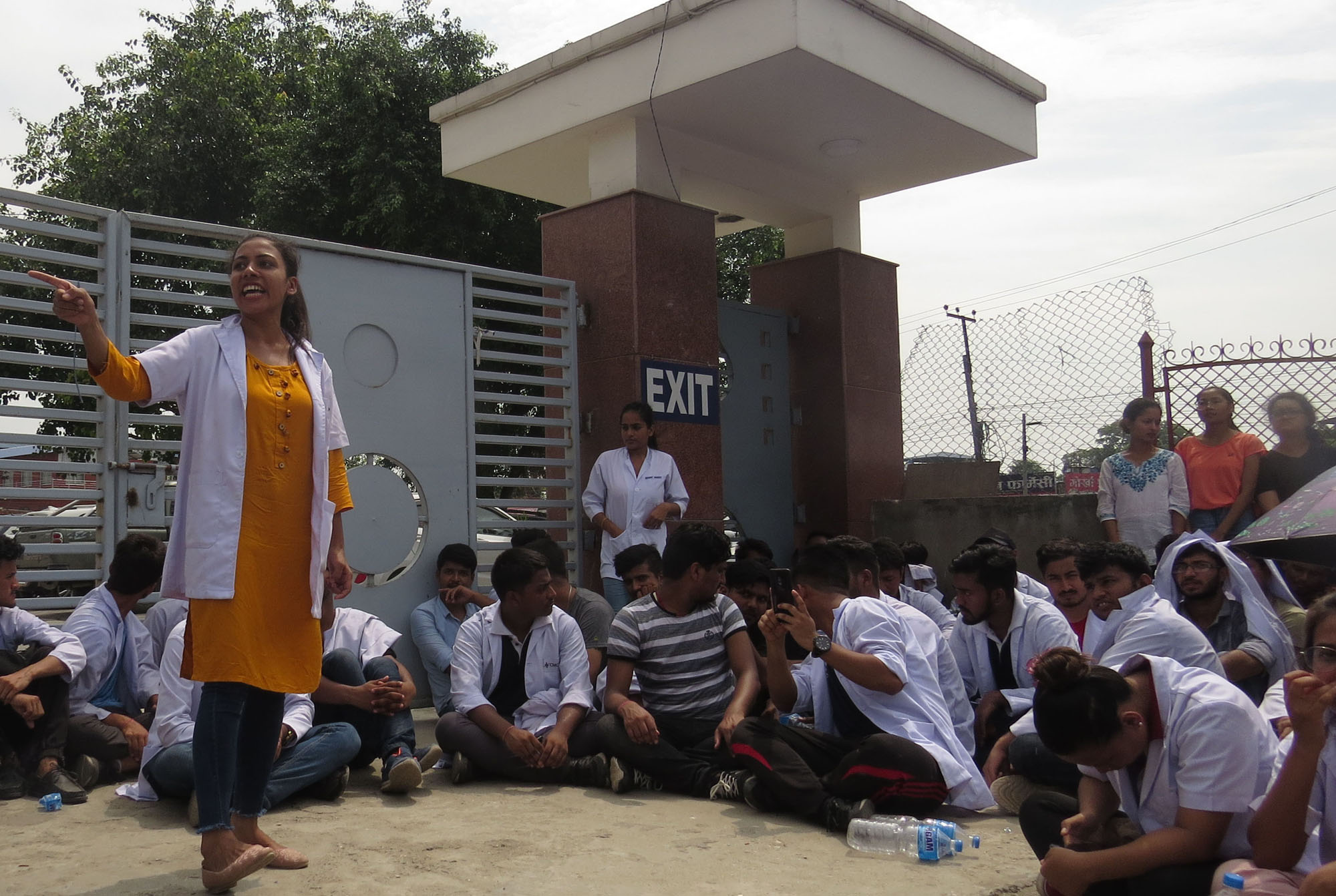
The MBBS students who were forced to pay exorbitant fees want a refund of the additional money the colleges charged. Though all the 18 private medical colleges have been found breaching the government ceiling, students particularly from Chitwan Medical College and Gandaki Medical College are hitting the streets, demanding that the extra money they paid be refunded. The students staged similar protests in April, forcing the Ministry of Education to direct the medical schools to return the money they had collected extra. But the medical colleges ignored the ministry’s directive. With no signs of the medical colleges complying with the directive, the students have been demonstrating for around a month. Though the operator of Chitwan Medical College promised the students a refund of their extra payments, the commitment has not been honoured.
Students have demanded that medical colleges stick to the fee ceiling set by the government. Keshav Thapa/TKP
Why aren’t the medical colleges abiding by the government fee ceiling?
The reluctance of the government to enforce the fee ceiling has emboldened medical college operators. The owners of a majority of private medical colleges have a nexus with major political parties, which they use to breach the rules. Basruddin Ansari, chairman of the Association of Medical and Dental Colleges of Nepal, is a leader of the ruling Nepal Communist Party (NCP). Khuma Aryal, the owner of Gandaki Medical College, has close links with the Nepali Congress top leadership. He was on the list of Nepali Congress candidates for proportional representation quotas of the House of Representatives last election. Suresh Kanodiya, the owner of Nepalgunj Medical College, is a local Congress leader. Medical college operators also fund political parties’ election campaigns.
What has come out of the students’ protest?
As medical colleges enjoy political patronage, it is the students’ protest that has compelled the college operators and the government to take some measures to check the malpractices. It was only after the weeks-long students’ agitation that the Chitwan Medical College and Gandaki Medical College agreed six months ago to refund the extra fees they had extracted from the students. However, they didn’t fulfil their commitments. Formation of a subcommittee under the Education and Health Committee of Parliament was a result of the student protests. The stir also forced the Ministry of Education to issue the directive against the colleges to abide by the government ceiling and refund the fees charged above the cap. With no sign of the colleges returning such payments, the ministry itself has taken the initiative to ensure that the students get their money back. A team led by Education Secretary Mahesh Dahal is working to ascertain which colleges overcharged the students and to what extent.
Has the relentless protest by Dr KC brought any changes?
It definitely has. It was Dr KC’s repeated hunger strikes that forced the government to form a high-level task force led by Kedar Bhakta Mathema, former vice-chancellor at the Tribhuvan University, which prepared the Health Profession Education Policy in 2015. The policy incorporated a majority of the activist’s demands and formed the basis for the National Medical Education Act that governs the entire medical education sector. A 10-year moratorium was placed on the establishment of medical colleges in Kathmandu Valley. Among the country’s 23 medical colleges, seven lie inside Kathmandu Valley while four more have got the letter of intent for their operation. Dr KC says that medical colleges must be opened in the mofussil to decentralise the medical education and health services.
Lack of proper monitoring is a major problem plaguing the medical education sector. Therefore, Dr KC has demanded that one university must not be allowed to grant affiliations to more than five medical colleges. The National Medical Education Act, however, hasn’t fully embraced the policy. The Act bans affiliations to more than five medical colleges but it has given a discretionary authority to the Medical Education Commission to decide for the colleges that have already received the letter of intent to operate outside the Capital.
Students of Chitwan Medical College protest in Bharatpur demanding a refund of the fees they had been charged extra. Ramesh Kumar Poudel/TKP
What could be the role of Medical Education Commission to resolve the problem?
The very objective of forming the commission is to regulate the medical education sector. It bears the responsibility of fixing the fees for the MBBS and BDS and other medical courses, determine the seats of medical colleges and also take decisions on the affiliations. The Act authorises the commission to ensure that the government fee ceiling is implemented and to take necessary action if that is not done. The commission that became functional a month ago, however, is not willing to take up past cases. It wants the Education Ministry to clear the issues regarding the reimbursement of college fees. It is currently working to determine the new fee structure with an aim to enforce it from the new academic session that begins shortly. The commission, therefore, seems ready to manage the issues that erupted after its commencement but not to take the baggage from the past.
What do the medical college operators say?
Once the government announced that it would recover the additional fees charged by the medical colleges at any cost, their owners came to Kathmandu to warn that they would not enrol students. They said that they are not in a position to operate their academic institutions in the given conditions. They are against the government’s decision to slash the MBBS seats to 100 from 150 and BDS seats to 50 from 75. Talking to the Post on September 25, Ansari had said the government must allow them to enrol more foreign students if it wants them to provide education to Nepali students for a lower fee. They charge foreign students double the fees levied on Nepali students. They want every student who has faced the National Eligibility cum Entrance Test in India to get admission directly to a Nepali medical college. Currently, foreign students willing to pursue a medical degree in colleges under Tribhuvan University have to take entrance tests conducted by the Institute of Medicine.
What is the long-term solution?
The problem arose mainly due to the inefficiency of the government and the universities in implementing the fee ceiling they have fixed and the absence of proper monitoring. There has been a trend in granting affiliations to medical schools under ‘influence’, which Dr KC has been objecting to for long. There will be no problems in the sector once medical colleges are forced to abide by the laws. Now the medical education commission shoulders the responsibility for bringing such colleges on track. The more efficient the commission, the better would be the medical education sector.
However, the role of political leadership also comes into play. Medical colleges can never challenge the authorities if they don’t have political backing. Often, college owners threaten to hand over their property to the government. The government must have the courage to take over the property of these colleges after proper valuation if they issue such warning again. The lesser the presence of the private sector in the medical education sector, the fewer the problems.
Binod Ghimire covers parliamentary affairs and human rights for The Kathmandu Post. Since joining the Post in 2010, he has reported primarily on social issues, focusing on education and transitional justice.




 17.79°C Kathmandu
.jpg&w=900&height=601)