Last month, I wrote, “Unless Japanese Prime Minister Yoshihide Suga acts quickly, more lives will be lost, and his own political position may become yet another victim of the virus.” This has now come to pass.
On September 3, Suga announced that he will not seek re-election as president of the Liberal Democratic Party in its leadership election on September 29. Because the LDP holds a majority in the House of Representatives (with its coalition partner, the Komei Party), its next leader will automatically become the new prime minister. The LDP leadership election will then be followed by a general election in October or November, when the current four-year parliamentary term expires. Because the LDP is most likely to win the election, the leader it selects this month will become prime minister for the next term.
Suga’s tenure as prime minister will have lasted only around a year. The announcement of his departure spurred a sharp increase in stock prices, with the Nikkei 225 rising more than 2 percent on the day and maintaining an upward trend ever since. Markets previously had given significant weight to the possibility of Suga hobbling on as a weak prime minister and losing this fall’s general election and the Upper House election next July. Now that this scenario has been eliminated, the market is reacting positively, despite the uncertainty about Suga’s successor.
Suga did try to manoeuvre for a re-election fight, but he never managed to gain the necessary momentum. His low approval ratings (below 30 percent) had left younger LDP members worried about the party’s ability to hold onto its parliamentary majority. Electorally vulnerable members with far less experience in the Diet (parliament) had been searching for a more popular leader.
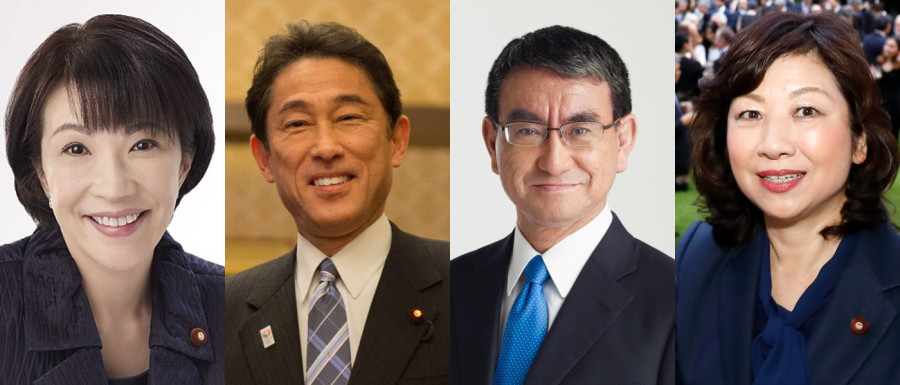
With Suga’s vulnerability becoming more apparent, members of parliament such as Fumio Kishida and Sanae Takaichi decided to throw their hats into the ring. And following Suga’s decision to exit, Taro Kono, a reform-minded veteran, decided to join the race, too. And at the last moment, Seiko Noda, a former minister of internal affairs and communications, threw her hat into the ring.
Kishida, Japan’s minister of foreign affairs from 2012 to 2017, is known for his liberal agenda. In his campaign for the LDP presidency, he has advocated a shift away from neoliberal economic policies and called for “tens of trillions of yen” in fiscal stimulus (100 yen is around $0.92). He argues that redistribution toward lower-income households would foster more sustainable growth, and he supports doubling the incomes of people in the medical, childcare, and long-term care professions.
Takaichi, who served as minister of internal affairs and communications under former prime minister Shinzo Abe, is known as more of a conservative hawk. She supports revising (or reinterpreting) the constitution to broaden the remit of the Self-Defense Forces, so that it is empowered to strike an enemy preemptively, rather than only in response to an attack.
Takaichi’s conservatism extends to social policy as well. For example, she opposes same-sex marriage and separate surnames for husband and wife. On the economic policy front, however, she would revive and sustain the expansionary monetary and fiscal policies of Abenomics, only with a new name: “Sanaenomics.” Channelling Modern Monetary Theory, she favours an unlimited increase in fiscal stimulus until the 2 percent inflation target is reached.
Kono, for his part, currently oversees the country’s Covid-19 vaccination rollout, and previously served as minister of foreign affairs from 2017 to 2019 and as minister of defense from 2019 to 2020. He is known as a reformer who is not afraid to face down bureaucratic resistance. In his bid for the LDP presidency, he has claimed credit for the acceleration of vaccinations after a long initial delay, boasting that he has secured a sufficient supply of doses and established large vaccination sites. While he previously advocated phasing out the country’s nuclear power plants, he seems to have switched to a more moderate position that would allow existing plants to continue or resume operations in accordance with stringent safety standards.
In terms of economic policy, while Kono has floated the idea of a corporate tax break for firms that keep the labour share of income above a certain level, he does not have any specific new proposals for monetary or fiscal policy. When asked recently about fiscal stimulus, he responded that the destination of public investment is as important as the amount, thereby dodging the question of spending levels. Though he is considered somewhat radical, his policy platform is relatively moderate, to the disappointment of his traditional supporters.
In fact, Noda’s last-minute candidacy could draw votes away from Kono. She will run on a platform of helping the low-income and disadvantaged.
None of the candidates would change Japan’s close relations with its Western allies. As the most “right-wing” of the three, Takaichi’s cultivation of support among Japanese nationalists would probably stoke tensions with China. She has already visited the Yasukuni Shrine, whose Book of Souls contains the names of around 1,000 Japanese convicted of war crimes after World War II.
On the specific question of fiscal stimulus, Takaichi, the MMT advocate, is the most ambitious, followed by Kishida. None is advocating a change in the inflation targeting framework or the Bank of Japan’s 2 percent inflation target.
According to the most recent Nikkei poll, Kono was leading with 27 percent support, followed by Shigeru Ishiba (17 percent), who has since dropped out of the running and endorsed Kono. Next came Kishida at 14 percent, with Takaichi at 7 percent and Noda at 2 percent.
An LDP leadership election involves both rank-and-file party supporters and LDP Diet members. Generally speaking, LDP Diet members will be swayed by factional politicking, injecting more uncertainty into the mix than public polling would suggest. But this time may be different. With the general election only a month away, a candidate’s popularity among the party base will weigh heavily on individual Diet members’ decisions. That makes Kono the clear front-runner.




 19.57°C Kathmandu